-
Sale!
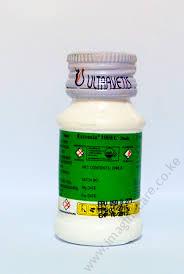 Ectomin 100EC is a highly efficient ectoparasiticide used to eliminate fleas, flies, tsetse flies, and ticks in chicken, cattle, sheep, goats, cats, camels, pigs, and dogs.
 -
Sale!
Ectomin 100EC is a highly efficient ectoparasiticide used to eliminate fleas, flies, tsetse flies, and ticks in chicken, cattle, sheep, goats, cats, camels, pigs, and dogs.
-
 Steladone EC 300 is a world-class broad-spectrum acaricide and insecticide. The key active ingredient of this product is Chlorfenvinphos, an organophosphate cholinesterase inhibitor. It is a stable emulsifiable concentrate formulated to control all stages of tick species, keds, screw worms, fleas, and sucking, and biting lice. It protects sheep from blowfly strikes and is effective in controlling sheep scabs. It is also used to control parasites resistant to chlorinated hydrocarbons
 -
Steladone EC 300 is a world-class broad-spectrum acaricide and insecticide. The key active ingredient of this product is Chlorfenvinphos, an organophosphate cholinesterase inhibitor. It is a stable emulsifiable concentrate formulated to control all stages of tick species, keds, screw worms, fleas, and sucking, and biting lice. It protects sheep from blowfly strikes and is effective in controlling sheep scabs. It is also used to control parasites resistant to chlorinated hydrocarbons
-
Steladone EC 300 is a world-class broad-spectrum acaricide and insecticide. The key active ingredient of this product is Chlorfenvinphos, an organophosphate cholinesterase inhibitor. It is a stable emulsifiable concentrate formulated to control all stages of tick species, keds, screw worms, fleas, and sucking, and biting lice. It protects sheep from blowfly strikes and is effective in controlling sheep scabs. It is also used to control parasites resistant to chlorinated hydrocarbons
-
Steladone EC 300 is a world-class broad-spectrum acaricide and insecticide. The key active ingredient of this product is Chlorfenvinphos, an organophosphate cholinesterase inhibitor. It is a stable emulsifiable concentrate formulated to control all stages of tick species, keds, screw worms, fleas, and sucking, and biting lice. It protects sheep from blowfly strikes and is effective in controlling sheep scabs. It is also used to control parasites resistant to chlorinated hydrocarbons
-
Steladone EC 300 is a world-class broad-spectrum acaricide and insecticide. The key active ingredient of this product is Chlorfenvinphos, an organophosphate cholinesterase inhibitor. It is a stable emulsifiable concentrate formulated to control all stages of tick species, keds, screw worms, fleas, and sucking, and biting lice. It protects sheep from blowfly strikes and is effective in controlling sheep scabs. It is also used to control parasites resistant to chlorinated hydrocarbons
-
Steladone EC 300 is a world-class broad-spectrum acaricide and insecticide. The key active ingredient of this product is Chlorfenvinphos, an organophosphate cholinesterase inhibitor. It is a stable emulsifiable concentrate formulated to control all stages of tick species, keds, screw worms, fleas, and sucking, and biting lice. It protects sheep from blowfly strikes and is effective in controlling sheep scabs. It is also used to control parasites resistant to chlorinated hydrocarbons
-
Steladone EC 300 is a world-class broad-spectrum acaricide and insecticide. The key active ingredient of this product is Chlorfenvinphos, an organophosphate cholinesterase inhibitor. It is a stable emulsifiable concentrate formulated to control all stages of tick species, keds, screw worms, fleas, and sucking, and biting lice. It protects sheep from blowfly strikes and is effective in controlling sheep scabs. It is also used to control parasites resistant to chlorinated hydrocarbons
-
 What Is a Nantes Carrot? This type is as French as the city of Nantes, where it was developed by the Vilmorin-Andrieux seed company in the 1850s. Since those days, the original has been tapped as one of the parent crops to create a number of other cultivars, and all of them are now considered “Nantes-style” varieties
 -
What Is a Nantes Carrot? This type is as French as the city of Nantes, where it was developed by the Vilmorin-Andrieux seed company in the 1850s. Since those days, the original has been tapped as one of the parent crops to create a number of other cultivars, and all of them are now considered “Nantes-style” varieties
-
What Is a Nantes Carrot? This type is as French as the city of Nantes, where it was developed by the Vilmorin-Andrieux seed company in the 1850s. Since those days, the original has been tapped as one of the parent crops to create a number of other cultivars, and all of them are now considered “Nantes-style” varieties
-
What Is a Nantes Carrot? This type is as French as the city of Nantes, where it was developed by the Vilmorin-Andrieux seed company in the 1850s. Since those days, the original has been tapped as one of the parent crops to create a number of other cultivars, and all of them are now considered “Nantes-style” varieties
-
What Is a Nantes Carrot? This type is as French as the city of Nantes, where it was developed by the Vilmorin-Andrieux seed company in the 1850s. Since those days, the original has been tapped as one of the parent crops to create a number of other cultivars, and all of them are now considered “Nantes-style” varieties
-
What Is a Nantes Carrot? This type is as French as the city of Nantes, where it was developed by the Vilmorin-Andrieux seed company in the 1850s. Since those days, the original has been tapped as one of the parent crops to create a number of other cultivars, and all of them are now considered “Nantes-style” varieties
-
Sale!

 Essie Mugo's Cockroach Gel is a professional-grade pest control product that is designed to eliminate cockroaches from your home or business. The gel formula is easy to apply and spreads quickly, reaching into hard-to-reach areas where cockroaches like to hide. It contains a highly attractive bait that lures cockroaches out of their hiding spots, leading them to ingest the poison and ultimately die.
 -
Sale!
 Essie Mugo's Cockroach Gel is a professional-grade pest control product that is designed to eliminate cockroaches from your home or business.
 -
What Is a Nantes Carrot? This type is as French as the city of Nantes, where it was developed by the Vilmorin-Andrieux seed company in the 1850s. Since those days, the original has been tapped as one of the parent crops to create a number of other cultivars, and all of them are now considered “Nantes-style” varieties
-
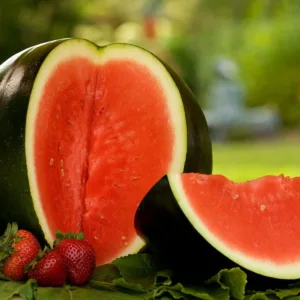 Watermelon Sugar Baby is a widely adapted heirloom variety is solid, dark green on the outside with a bright red, firm and fine-grained flesh that is super sweet. Watermelon contains high levels of healthy antioxidants, making Sugar Baby a great sweet way to pack in good nutrition. Vines are compact. Plant about 4 feet apart.
 -
Watermelon Sugar Baby is a widely adapted heirloom variety is solid, dark green on the outside with a bright red, firm and fine-grained flesh that is super sweet. Watermelon contains high levels of healthy antioxidants, making Sugar Baby a great sweet way to pack in good nutrition. Vines are compact. Plant about 4 feet apart.
-
Watermelon Sugar Baby is a widely adapted heirloom variety is solid, dark green on the outside with a bright red, firm and fine-grained flesh that is super sweet. Watermelon contains high levels of healthy antioxidants, making Sugar Baby a great sweet way to pack in good nutrition. Vines are compact. Plant about 4 feet apart.
-
Watermelon Sugar Baby is a widely adapted heirloom variety is solid, dark green on the outside with a bright red, firm and fine-grained flesh that is super sweet. Watermelon contains high levels of healthy antioxidants, making Sugar Baby a great sweet way to pack in good nutrition. Vines are compact. Plant about 4 feet apart.
-
Watermelon Sugar Baby is a widely adapted heirloom variety is solid, dark green on the outside with a bright red, firm and fine-grained flesh that is super sweet. Watermelon contains high levels of healthy antioxidants, making Sugar Baby a great sweet way to pack in good nutrition. Vines are compact. Plant about 4 feet apart.
-
Watermelon Sugar Baby is a widely adapted heirloom variety is solid, dark green on the outside with a bright red, firm and fine-grained flesh that is super sweet. Watermelon contains high levels of healthy antioxidants, making Sugar Baby a great sweet way to pack in good nutrition. Vines are compact. Plant about 4 feet apart.
-
 A full body harness consists of straps passed over the shoulders, across the chest, and around the legs. In a fall, a full body harness protects you more than a safety belt because the harness distributes the force of impact over a greater area of your body.
 -
 Lanyards without energy absorbers, such as rope or web lanyards and chain rebar assemblies, are designed for positioning or restraint applications.
 -
 This rope shares the weight of a load between the core and the cover, giving it added strength. It's made of nylon, which compensates for sudden force, such as in towing applications or dock lines. The braided cover protects the braided core from wear during use. The rope resists rot and mildew.
 -
 Twin Webbing Shock Absorber Lanyard EN 355 with energy absorber fall arrester fitted with 2 textile wrenches, 26mm wide webbing and one screw karabiner AM002 and two snap hooks. Length folded: 2m. Length unfolded: 3,20mt. Conforms to BS EN 355:2002, PPE energy absorbers.
 -
 A full body harness is a harness designed to hold the wearer upright in the event of a fall from height. If worn correctly, a full body harness will distribute the energy generated during free-fall across the wearers' body evenly, reducing the potential for serious injury.
 -
 Terere, lidodo, alika or muchicha are the common names used for amaranth (Amaranthus viridis) among different communities in Kenya. Amaranth is a fast-growing annual crop belonging to the Amaranthacea family
 -
Terere, lidodo, alika or muchicha are the common names used for amaranth (Amaranthus viridis) among different communities in Kenya. Amaranth is a fast-growing annual crop belonging to the Amaranthacea family
-
Terere, lidodo, alika or muchicha are the common names used for amaranth (Amaranthus viridis) among different communities in Kenya. Amaranth is a fast-growing annual crop belonging to the Amaranthacea family
-

 Coriander is an annual herb in the family of Apiaceae. It is also known as cilantro, particularly in America and other in India. Coriander is most commonly used as a garnish on most Indian Sabzis. The leaves are variable in shape, broadly lobed at the base of the plant, and slender and feathery higher on the flowering stems. All parts of the plant are edible, but the fresh leaves and the dried seeds are commonly used in cooking. The leaves have a different taste from the seeds, with citrus overtones.
 -
Coriander is an annual herb in the family of Apiaceae. It is also known as cilantro, particularly in America and other in India. Coriander is most commonly used as a garnish on most Indian Sabzis. The leaves are variable in shape, broadly lobed at the base of the plant, and slender and feathery higher on the flowering stems. All parts of the plant are edible, but the fresh leaves and the dried seeds are commonly used in cooking. The leaves have a different taste from the seeds, with citrus overtones.
-
Coriander is an annual herb in the family of Apiaceae. It is also known as cilantro, particularly in America and other in India. Coriander is most commonly used as a garnish on most Indian Sabzis. The leaves are variable in shape, broadly lobed at the base of the plant, and slender and feathery higher on the flowering stems. All parts of the plant are edible, but the fresh leaves and the dried seeds are commonly used in cooking. The leaves have a different taste from the seeds, with citrus overtones.
-
Coriander is an annual herb in the family of Apiaceae. It is also known as cilantro, particularly in America and other in India. Coriander is most commonly used as a garnish on most Indian Sabzis. The leaves are variable in shape, broadly lobed at the base of the plant, and slender and feathery higher on the flowering stems. All parts of the plant are edible, but the fresh leaves and the dried seeds are commonly used in cooking. The leaves have a different taste from the seeds, with citrus overtones.
-
Coriander is an annual herb in the family of Apiaceae. It is also known as cilantro, particularly in America and other in India. Coriander is most commonly used as a garnish on most Indian Sabzis. The leaves are variable in shape, broadly lobed at the base of the plant, and slender and feathery higher on the flowering stems. All parts of the plant are edible, but the fresh leaves and the dried seeds are commonly used in cooking. The leaves have a different taste from the seeds, with citrus overtones.
-
Coriander is an annual herb in the family of Apiaceae. It is also known as cilantro, particularly in America and other in India. Coriander is most commonly used as a garnish on most Indian Sabzis. The leaves are variable in shape, broadly lobed at the base of the plant, and slender and feathery higher on the flowering stems. All parts of the plant are edible, but the fresh leaves and the dried seeds are commonly used in cooking. The leaves have a different taste from the seeds, with citrus overtones.
-
 Detroit Dark Red heirloom beets are vegetables that hail from Ontario, Canada, where Mr. Reeves developed them from blood turnips. This globular beet first made its appearance in 1892. However, beets seem to have originated in the Mediterranean region, where people grew them for thousands of years. Later, red beets grew in Germany and Holland, where these vegetables were used as cattle fodder; they were later imported to England for this purpose, but the poor began to raise them for an affordable food source. American colonists later brought red beets to the New World, where they became a commonly enjoyed vegetable both for their roots and their greens.
 -
Detroit Dark Red heirloom beets are vegetables that hail from Ontario, Canada, where Mr. Reeves developed them from blood turnips. This globular beet first made its appearance in 1892. However, beets seem to have originated in the Mediterranean region, where people grew them for thousands of years. Later, red beets grew in Germany and Holland, where these vegetables were used as cattle fodder; they were later imported to England for this purpose, but the poor began to raise them for an affordable food source. American colonists later brought red beets to the New World, where they became a commonly enjoyed vegetable both for their roots and their greens.
-
Detroit Dark Red heirloom beets are vegetables that hail from Ontario, Canada, where Mr. Reeves developed them from blood turnips. This globular beet first made its appearance in 1892. However, beets seem to have originated in the Mediterranean region, where people grew them for thousands of years. Later, red beets grew in Germany and Holland, where these vegetables were used as cattle fodder; they were later imported to England for this purpose, but the poor began to raise them for an affordable food source. American colonists later brought red beets to the New World, where they became a commonly enjoyed vegetable both for their roots and their greens.
-
Detroit Dark Red heirloom beets are vegetables that hail from Ontario, Canada, where Mr. Reeves developed them from blood turnips. This globular beet first made its appearance in 1892. However, beets seem to have originated in the Mediterranean region, where people grew them for thousands of years. Later, red beets grew in Germany and Holland, where these vegetables were used as cattle fodder; they were later imported to England for this purpose, but the poor began to raise them for an affordable food source. American colonists later brought red beets to the New World, where they became a commonly enjoyed vegetable both for their roots and their greens.
-
Detroit Dark Red heirloom beets are vegetables that hail from Ontario, Canada, where Mr. Reeves developed them from blood turnips. This globular beet first made its appearance in 1892. However, beets seem to have originated in the Mediterranean region, where people grew them for thousands of years. Later, red beets grew in Germany and Holland, where these vegetables were used as cattle fodder; they were later imported to England for this purpose, but the poor began to raise them for an affordable food source. American colonists later brought red beets to the New World, where they became a commonly enjoyed vegetable both for their roots and their greens.
-
Detroit Dark Red heirloom beets are vegetables that hail from Ontario, Canada, where Mr. Reeves developed them from blood turnips. This globular beet first made its appearance in 1892. However, beets seem to have originated in the Mediterranean region, where people grew them for thousands of years. Later, red beets grew in Germany and Holland, where these vegetables were used as cattle fodder; they were later imported to England for this purpose, but the poor began to raise them for an affordable food source. American colonists later brought red beets to the New World, where they became a commonly enjoyed vegetable both for their roots and their greens.
-
 Fordhook Giant is a faster growing Swiss chard variety. It has white petioles with large, semi-savoy, green leaves. It is a bolt-tolerant variety and has an upright plant habit. Fordhook Giant is the perfect choice for fresh market growers or home gardeners.
 -
Fordhook Giant is a faster growing Swiss chard variety. It has white petioles with large, semi-savoy, green leaves. It is a bolt-tolerant variety and has an upright plant habit. Fordhook Giant is the perfect choice for fresh market growers or home gardeners.
-
Fordhook Giant is a faster growing Swiss chard variety. It has white petioles with large, semi-savoy, green leaves. It is a bolt-tolerant variety and has an upright plant habit. Fordhook Giant is the perfect choice for fresh market growers or home gardeners.
-
Fordhook Giant is a faster growing Swiss chard variety. It has white petioles with large, semi-savoy, green leaves. It is a bolt-tolerant variety and has an upright plant habit. Fordhook Giant is the perfect choice for fresh market growers or home gardeners.
-
Fordhook Giant is a faster growing Swiss chard variety. It has white petioles with large, semi-savoy, green leaves. It is a bolt-tolerant variety and has an upright plant habit. Fordhook Giant is the perfect choice for fresh market growers or home gardeners.
-
Fordhook Giant is a faster growing Swiss chard variety. It has white petioles with large, semi-savoy, green leaves. It is a bolt-tolerant variety and has an upright plant habit. Fordhook Giant is the perfect choice for fresh market growers or home gardeners.

FOLLOW US on meta
services
shop
legal
How to pay


Get offers & updates
Copyright © 2026• Imagine Care Limited• All rights reserved